
When you need legal or official translation in Dubai, it is not enough for the language to be correct. For courts, notaries, and many government authorities, your translated documents must be MOJ approved – formally recognized by the UAE Ministry of Justice. Understanding how this approval works can save you time, prevent rejections, and protect you from legal complications.
This step-by-step guide explains how MOJ approved translation in Dubai works, which documents need it, where the Ministry of Justice fits into the process, and how a professional provider such as Al Rahmaniya Legal Translation can manage everything on your behalf. If you are still comparing different legal translation providers and attestation services, make sure you also read the main guide: Read complete overview: “The Complete Guide to Choosing a Legal Translation Company in Dubai for Document Translation and Attestation Services.”
What Is MOJ Approved Translation in Dubai?
In the UAE, a translation becomes legally valid for courts and many government purposes only when it is produced by a translator who is licensed and approved by the Ministry of Justice (MOJ). This process is often referred to as MOJ approved translation Dubai or legal translation approval Dubai.
Key Characteristics of MOJ Approved Legal Translation
- Performed by a sworn translator: The translator must be registered, tested, and licensed by the UAE MOJ for specific language pairs.
- Includes official stamp and declaration: Each page carries a legal translator’s stamp, license number, and certification statement.
- Accepted as evidence: Courts, notary public, and many authorities in Dubai, Bur Dubai, Deira, and Karama treat it as legally valid evidence.
- Follows strict formatting: The translation must mirror the structure of the original, especially for contracts, judgments, and official certificates.
When you see the phrase ministry of justice translation Dubai, it does not always mean the ministry itself translated your document. Instead, it usually refers to translations done by MOJ-licensed translators or companies that are authorized to provide these services, like Al Rahmaniya Legal Translation.
Which Documents Need MOJ Approved or Certified Legal Translation in Dubai?
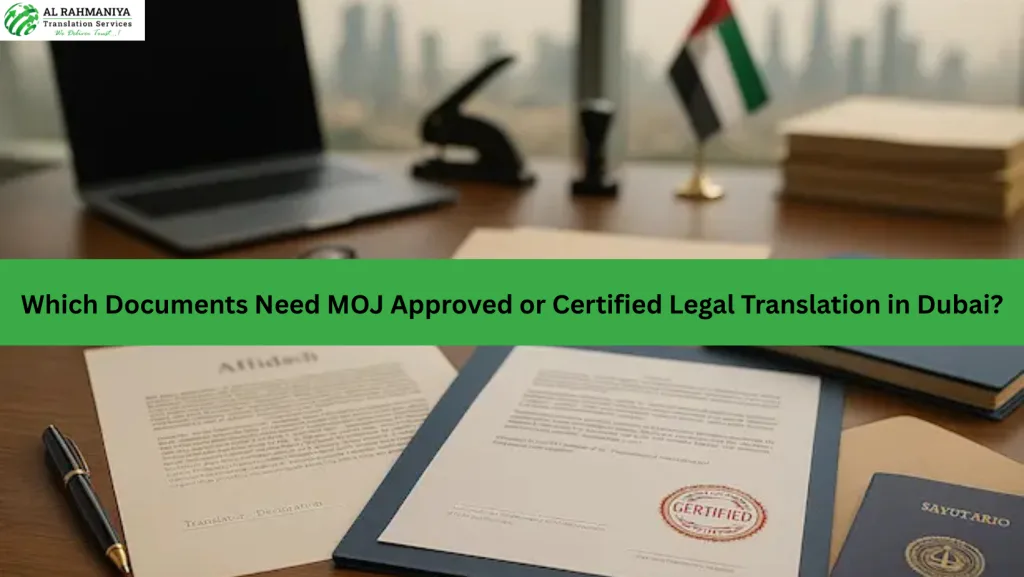
Not every translated document in Dubai must be MOJ approved. However, any document that will be used in court, before the public prosecutor, notary public, or certain government entities typically requires certified legal translation in Dubai from an MOJ-approved translator.
Common Document Categories
| Document Type | Examples | MOJ Approval Usually Needed? |
|---|---|---|
| Civil Status Documents | Birth, marriage, divorce, death certificates | Yes, for court or government use |
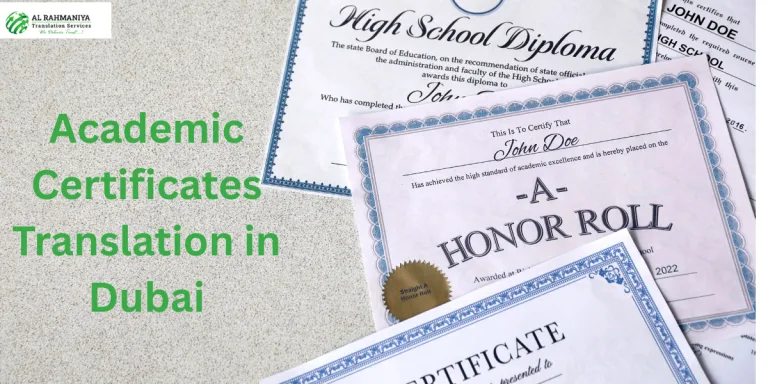
| Academic Certificates | Degrees, diplomas, transcripts | Yes, for equivalency, licensing, immigration |
| Legal & Court Documents | Judgments, statements of claim, powers of attorney | Always |
| Corporate & Commercial | MOA, AOA, board resolutions, commercial licenses | Often, depending on authority |
| Contracts & Agreements | Employment contracts, lease agreements, service contracts | Usually, if notarized or submitted to a government body |
| Immigration & Residency | Police clearance, bank statements, sponsor documents | Varies, but certified translation is frequently required |
When in doubt, ask the receiving authority whether they require official translation in Dubai from an MOJ approved legal translator. If you contact Al Rahmaniya Legal Translation, our team can also verify the requirement for your specific case with Dubai-based authorities.
How the Ministry of Justice Translation Approval System Works
To understand the step-by-step process, it helps to see where the Ministry of Justice fits into the larger ecosystem of legal translation approval in Dubai.
The MOJ’s Role in Legal Translation
- Licensing translators: The MOJ conducts exams, verifies qualifications, and issues licenses to translators for specific languages (e.g., English to Arabic, French to Arabic).
- Regulating quality: It sets standards for formatting, terminology, and certification statements for certified legal translation Dubai.
- Recognizing official translation: Authorities in Dubai trust translations that carry the stamp of a MOJ-licensed translator or approved company.
When you submit documents to a court in Deira, a notary in Bur Dubai, or a government department in Karama, officials primarily look for:
- The MOJ-licensed translator’s stamp and license number.
- A signed certification statement confirming accuracy.
- Matching language pairs (e.g., the translator is licensed specifically for English–Arabic).
Therefore, choosing a provider like Al Rahmaniya Legal Translation, which works exclusively with MOJ-approved translators, ensures your official translation in Dubai is recognized by the relevant authority.
Step-by-Step Guide: How MOJ Approved Translation in Dubai Works

The exact procedure can vary slightly depending on your document type and where it was issued. However, the following step-by-step guide reflects the standard path for MOJ approved translation in Dubai for most personal and corporate documents.
Step 1: Determine your Target Authority and Requirements
Before translating anything, clarify where the document will be submitted. For example:
- Dubai Courts or Public Prosecution
- Notary public in Bur Dubai or Deira
- Dubai Land Department or DED
- Immigration (GDRFA) or a free zone authority
Check whether they require:
- Arabic-only legal translation in Dubai, or Arabic and English versions
- Attested originals (e.g., from UAE Ministry of Foreign Affairs) before translation
- Hard copies with wet-ink stamps versus electronic submissions
Al Rahmaniya Legal Translation regularly handles inquiries from Dubai, Karama, Bur Dubai, and Deira, and can guide you on which format and certifications you will need.
Step 2: Verify the Authenticity and Attestation of the Original Document
For foreign-issued documents, translation is often not the first step. Many authorities require:
- Notarization in the country of origin
- Authentication by the foreign ministry in the issuing country
- UAE embassy attestation in that country
- Final MOFA (Ministry of Foreign Affairs) attestation in the UAE
Only after the original is fully attested should you arrange ministry of justice translation in Dubai. This ensures the translation reflects an already recognized official document.
Step 3: Choose an MOJ Approved Legal Translation Provider
At this stage, you must work with a sworn translator or a specialized company. When selecting a provider, confirm:
- They use MOJ-licensed translators for your language pair.
- They are familiar with your specific document type (e.g., court pleadings, corporate resolutions).
- They understand your target authority’s requirements in Dubai or elsewhere in the UAE.
- They can meet your deadline, especially for urgent court or notary submissions.
Al Rahmaniya Legal Translation, based in Dubai, offers MOJ-approved certified legal translation and can coordinate document pick-up or digital submission for clients in Deira, Bur Dubai, and Karama.
Step 4: Submit Clear Copies (or originals when required)
Accuracy depends heavily on the clarity of your documents. To avoid delays or errors:
- Provide high-resolution scans or digital PDFs.
- Ensure all stamps, seals, and handwritten notes are legible.
- Share any reference spellings for names or company details (e.g., passport spelling, trade license spelling).
For some types of official translation in Dubai (particularly for court), the translator or agency may need to see or handle physical originals. Your provider will advise you if this is necessary.
Step 5: Translation by MOJ Approved Legal Translator
This is the heart of MOJ approved translation Dubai. A sworn translator will:
- Translate the full text into the required language (usually Arabic for Dubai courts).
- Mirror the layout and sections of the original document as closely as possible.
- Use legally recognized terminology and phrasing in line with UAE legal practice.
- Insert translator notes where needed to explain seals, logos, or illegible parts.
Because this is not just linguistic work but legal work, it is essential to work with experts who specialize in certified legal translation in Dubai, not general translators.
Step 6: Internal Quality Review and Proofreading
Before certification, professional agencies like Al Rahmaniya Legal Translation typically perform an internal quality review:
- Cross-checking names, dates, and numbers.
- Ensuring consistency with previously translated documents (e.g., previous contracts or court filings).
- Confirming that required legal terminology matches Dubai Court practices.
This extra step reduces the risk of a judge, notary, or case officer questioning the translation.
Step 7: Certification, Stamping, and Signing
Once the translator is satisfied, the document is formally certified:
- The MOJ-licensed translator signs and stamps the translation.
- The certification statement is printed, often including phrases like “true and accurate translation of the original.”
- The translator’s name and MOJ license number are clearly visible.
For many purposes, this is enough to qualify as legal translation approval Dubai. However, in some complex or cross-border cases, the translation itself may also need further attestation.
Step 8: Additional Attestations (If Required)
In certain situations such as using translations abroad or in multi-jurisdictional disputes your official translation in Dubai might require additional stamps from:
- Dubai Courts or the Notary Public
- Ministry of Justice (for legalization of signatures)
- Ministry of Foreign Affairs (for international use)
Al Rahmaniya Legal Translation can coordinate these extra steps as part of a complete translation and attestation package for clients across Dubai, including Bur Dubai, Deira, and Karama.
Timelines and Costs: What to Expect for MOJ Approved Legal Translation
The time and cost of MOJ approved translation Dubai depend on several factors. Understanding these will help you plan court filings, visa applications, or business transactions more effectively.
Factors Affecting Turnaround Time
- Document length and complexity: A one-page certificate may be ready within hours; a 50-page contract or judgment can take several days.
- Language pair: Common pairs like English to Arabic are faster; rarer languages may require more coordination.
- Urgency: Express services are often available at a premium, particularly for court deadlines in Dubai.
- Attestation steps: If MOFA, embassy, or additional MOJ stamps are required, add extra working days.
Typical Cost Drivers
- Number of pages or words.
- Type of document (general certificate vs. complex legal pleading).
- Urgent vs. standard service.
- Additional attestation and government fees.
While each case is unique, choosing a specialized provider like Al Rahmaniya Legal Translation can help you avoid unnecessary costs (for example, translating documents that authorities do not actually need, or paying twice due to errors).
Common Mistakes That Lead to Rejection of Legal Translations in Dubai

Even small errors can cause serious delays or rejections when dealing with courts and government authorities. Below are frequent mistakes seen in translation in Dubai that you should actively avoid.
1. Using Non Licensed or Freelance Translators
Authorities typically do not accept translations done by translators who are not MOJ-licensed. Even if the language is perfect, the absence of an official stamp and license number will usually lead to rejection.
2. Ignoring Required Attestation Sequence
Translating a document before it is fully attested (e.g., by MOFA) can result in duplicated work. Many authorities want the translation of the final attested version, including all seals and endorsements.
3. Wrong or Inconsistent Name Spellings
If a name appears differently across your passport, visa, and certificates, authorities in Dubai may question the identity link between documents. An experienced provider of certified legal translation in Dubai will ask you to confirm standardized spellings in advance.
4. Using General Translation Instead of Official Legal Translation
For informal purposes like understanding a foreign text—general translation is fine. But for legal proceedings, you must use official translation in Dubai with full certification. Submitting unofficial translations to a court or notary will almost always be rejected.
5. Missing Deadlines and Court Dates
Legal processes in Dubai are date sensitive. Late translations can cause adjournments, extra costs, or missed opportunities. Working with a responsive, Dubai based agency such as Al Rahmaniya Legal Translation helps you match your filing schedule with realistic translation timelines.
How Al Rahmaniya Legal Translation Supports Your MOJ-Approved Translation Needs
Al Rahmaniya Legal Translation (ARLT) is a Dubai-based specialist in MOJ approved legal translation and document services. We support individuals, law firms, and businesses with end-to-end solutions for translation in Dubai, from initial document review through to final attestation.
Key Advantages of Working with ARLT
- MOJ approved translators: All legal translations are handled by sworn translators approved by the UAE Ministry of Justice.
- Coverage across Dubai: Convenient services for clients in Dubai’s key areas, including Bur Dubai, Deira, and Karama.
- Integrated services: Translation, notarization coordination, and document attestation (MOFA, MOJ, and more) under one roof.
- Confidentiality: Secure handling of sensitive legal and corporate documents.
- Fast turnaround: Standard and urgent options tailored to court and immigration timelines.
Whether you need ministry of justice translation Dubai for a single birth certificate or a bundle of contracts and court pleadings, Al Rahmaniya can manage the process, reduce your administrative burden, and help you avoid avoidable rejections.
Practical Tips to Smooth Your Legal Translation and Attestation Journey
A few practical steps can simplify your experience with legal translation approval Dubai and minimize back-and-forth with authorities.
- Start early: Begin translation and attestation as soon as you know you will need them (for example, before a filing deadline or visa appointment).
- Keep documents organized: Maintain a folder with all originals, attestations, and translations in both digital and physical form.
- Standardize spellings: Use one consistent spelling for names and company titles across all documents.
- Inform your translator of the context: Tell your provider whether the translation is for court, notary, licensing, or immigration terminology may differ.
- Use a single provider when possible: Working with one trusted partner such as Al Rahmaniya Legal Translation improves consistency and reduces errors.
FAQ: MOJ Approved Translation and Legal Translation Approval in Dubai
No. MOJ approval is mainly required for legal translation and documents submitted to courts, notaries, and specific government bodies. For internal use or general understanding, standard translation may be enough. When in doubt, ask the receiving authority or consult a specialist like Al Rahmaniya Legal Translation.
No. The MOJ does not simply “approve” translations done by unlicensed individuals. Legal translations must be carried out and certified by MOJ-licensed translators. You cannot self-translate and then request official endorsement.
For simple personal documents (e.g., certificates), you can often receive translations within the same day or next working day. Complex contracts or court files may take several days. Additional government attestations (MOFA, MOJ, etc.) will add processing time.
In many cases, you do not. By using a firm that provides ministry of justice translation Dubai services, most interactions with MOJ and other authorities can be handled on your behalf. For some notarization or court procedures, you may still need to appear personally or sign documents, but your translation provider can guide you.
This depends on the authority. Some accept scanned copies of signed and stamped translations; others require original hard copies. For example, many Dubai courts and notaries still prefer or require physical originals. Always confirm requirements with the receiving institution or ask Al Rahmaniya Legal Translation for case-specific advice.
Conclusion: Make MOJ-Approved Translation in Dubai Simple and Reliable
MOJ-approved legal translation in Dubai is a formal, regulated process that directly affects your court cases, visa applications, and business transactions. By understanding how MOJ approved translation Dubai works—who must perform it, which documents require it, and how attestation fits in—you greatly reduce the risk of costly delays or rejections.
Working with an experienced provider like Al Rahmaniya Legal Translation means your translations are handled by MOJ-licensed experts who know the expectations of authorities across Dubai, including Bur Dubai, Deira, and Karama. If you are currently choosing between different service providers or planning a broader documentation strategy, make sure to review the full pillar guide for additional selection criteria and best practices: Read complete overview: “The Complete Guide to Choosing a Legal Translation Company in Dubai for Document Translation and Attestation Services.”
For case-specific guidance, document review, or a quotation for your next legal translation and attestation project, you can contact Al Rahmaniya Legal Translation and have your documents translated accurately, efficiently, and in full compliance with UAE Ministry of Justice requirements.