
Choosing a legal translation company is not just about converting words from one language to another. It is about safeguarding meaning, intent, confidentiality, and compliance so your documents are accepted by authorities, partners, and courts. In Dubai, where cross-border transactions, immigration, and government interactions are routine, the right partner can make a significant difference.
This complete guide positions you to evaluate providers methodically, understand what a legal translation office delivers, and make confident decisions for official document translation in Dubai and document attestation. We break down processes, expectations, and quality measures by drawing on the experience of Al Rahmaniya Legal Translation Dubai, a trusted provider of MOJ approved legal translations, certified translations, and official document attestation services.
Whether you are a private individual, a corporate legal team, a university registrar, a financial institution, or a public sector entity, you will find practical checklists, a comparison table, and a decision framework you can apply immediately. Throughout, we keep a strong focus on accuracy, confidentiality, and timely delivery without speculating on specific costs or rules that require verification.
Quick Summary
This guide explains how to choose a reliable legal translation company in Dubai for certified legal translation, sworn translation Dubai, and document attestation. You will learn what services a legal translation office provides, how MOJ approved translation Dubai supports compliance, and how accuracy affects immigration, contracts, and industry-specific documentation. We include a comparison table of provider types, a step-by-step decision framework, and answers to common questions. If you need expert help, contact Al Rahmaniya Legal Translation for guidance and rapid turnaround with confidentiality at the core.
What a Legal Translation Company Actually Does
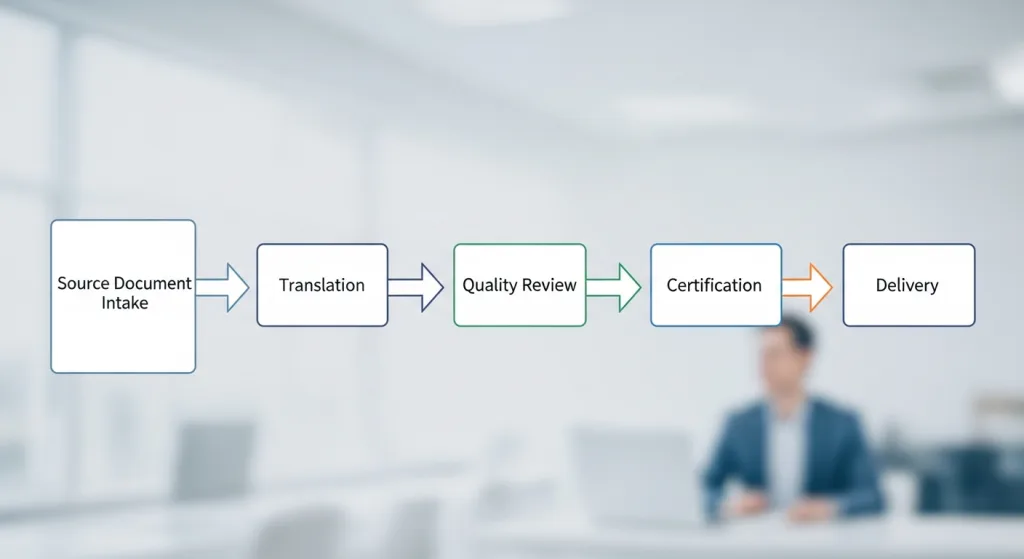
A reputable legal translation company specializes in rendering legally sensitive content accurately and in a form that is accepted by the intended authority or counterpart. The work extends well beyond language proficiency. It combines subject matter familiarity, terminology control, and documented processes that ensure completeness and traceability.
For many legal contexts, a certified translation office issues translations with the translator’s credentials or the firm’s certification statement attached. For certain authorities, MOJ approved translations are required for acceptance. When you evaluate any legal translation office, confirm their capabilities across three broad categories.
Core Service Areas
- Official document translation Dubai: personal identification, family records, immigration files, education certificates, employment documents, corporate records, and government submissions.
- Legal instruments and proceedings: contracts and agreements, powers of attorney, board resolutions, case pleadings, witness statements, and court-related documents.
- Sector-specific content: healthcare consents and medical reports, banking and compliance documents, technical manuals with legal implications, and public sector circulars.
Quality Controls You Should Expect
- You should expect quality controls such as terminology management and reference alignment to ensure the preservation of legal meaning and party obligations.
- You should expect an independent review or a second pair of eyes to ensure accuracy and completeness, particularly in the context of certified legal translation in Dubai.
- The formatting of the document should reflect the original structure, pagination, and annexes, as well as any necessary certification page or letterhead.
Confidentiality and Data Handling
- Access to files should be restricted to those with the necessary knowledge.
- Clear deletion or retention policies aligned with your needs.
- You should be prepared to sign Non-Disclosure Agreements (NDAs) as required by your clients.
If you are seeking a translation office Dubai that can handle sworn translations, always clarify what the receiving authority expects. In some cases, sworn translation Dubai refers to a translator recognized by a specific authority. In others, a company’s certification statement suffices.
Accuracy and Compliance: Why They Matter So Much
Legal translation is a fidelity exercise. A single misrendered term in a clause can shift obligations. A misinterpreted date format can block a visa process. A missing annex can delay an attestation. Compliance is equally crucial. Many filings in Dubai and across the UAE may require MOJ approved translation Dubai or a certified statement for official acceptance.
Choosing the correct legal translation company can assist you in aligning the translation format with the authority’s requirements, instead of adopting a uniform method.
Compliance-Driven Workflows
- Understanding the typical requests from receiving bodies and tailoring the deliverable form accordingly is crucial.
- We apply internal checklists for names, numbers, seals, and signatures.
- When an authority requests them, we prepare supporting letters or translator declarations accordingly.
Working With MOJ Approved Translators
When a matter calls for MOJ approved translation Dubai, your provider should allocate an approved translator and return a deliverable that reflects the required format. If your matter does not require MOJ approval, your provider can still issue a certified translation that includes a company seal and declaration. When in doubt, ask the provider to confirm the appropriate path, and verify with the receiving authority if needed.
How to Evaluate and Choose the Best Provider
Finding the best legal translation company in Dubai for legal work begins with a structured assessment. Consider these dimensions to make a confident choice that protects your interests.
Competence and Scope
- Does the legal translation office in Dubai have demonstrated experience in your document type and industry context
- Can they provide certified legal translation Dubai or MOJ approved services when required
- Do they handle attestation coordination if your workflow includes embassy or ministry steps
Quality and Review
- What is their review process and who performs it
- How do they manage terminology, glossaries, and references
- Can they mirror complex formatting and annexes without loss
Confidentiality and Security
- Do they implement secure file transfer and storage practices?
- Are NDAs available on request
- How do they limit translator access to sensitive files
Service, Turnaround, and Communication
- Do they offer clear timelines and realistic delivery estimates
- Is there a single point of contact for questions
- Can they accommodate urgent requests responsibly without sacrificing quality
Acceptance and Compliance
- Can the provider explain when certified translation office outputs suffice versus when MOJ approval is advisable
- Are they familiar with common requirements for courts, registrars, banks, or immigration bodies
- Will they assist you in assembling any supporting papers for attestation if needed
Al Rahmaniya Legal Translation supports individuals, companies, and law firms across Dubai with accuracy, confidentiality, and fast turnaround. If you need help deciding the correct deliverable for your authority, we can guide you through the options and format expectations. Contact Al Rahmaniya Legal Translation for expert assistance.
Industry Use Cases and What They Mean for Your Documents
Different industries carry different compliance and terminology burdens. Your legal translation company should adapt its process for each context so your documents align with sector expectations.
Legal Services
- Contracts, litigation filings, arbitration submissions, and witness statements often require meticulous terminology alignment and version control.
- Law firms benefit from providers that can manage multi-document bundles while keeping pagination and exhibit labeling intact.
Immigration and Visa Services
- Immigration authorities may require certified copies of birth and marriage records, police clearances, employment contracts, and salary letters.
- Accuracy in names, dates, and seals can meaningfully impact speedy decisions.
Healthcare and Medical
- Medical reports, discharge summaries, consent forms, and device instructions require precise clinical terminology.
- Providers should implement privacy-minded workflows to protect patient data.
Education and Universities
- Transcripts, diplomas, accreditation letters, and equivalency submissions often call for certified translations with the original layout mirrored when feasible.
- Registrars may require verifiable translator credentials.
Corporate and Commercial
- Articles of association, board resolutions, powers of attorney, and shareholder registers must maintain legal effect and consistency across languages.
- Vendors and customers may require bilingual contract sets with aligned clause numbering.
Government and Public Sector
- Circulars, permits, compliance filings, and policy drafts may require adherence to formal phrasing and clarity.
- Some submissions can call for MOJ approved translations.
Real Estate and Property
- Lease agreements, sale and purchase agreements, title-related documents, and NOCs must preserve legal obligations and references to plot numbers and units.
Financial Services and Banking
- KYC files, compliance attestations, account opening packages, guarantees, and letters of credit require consistent terminology and numerical accuracy.
- Acceptance expectations vary by institution.
Engineering and Technical
- Technical specifications, HSE manuals, and method statements sometimes carry legal weight when attached to contracts.
- Precision and consistency with engineering terms is critical.
E-commerce and Digital Businesses
- Terms of service, privacy policies, vendor contracts, and IP related documents should reflect clear and enforceable language in both source and target languages.
Accuracy in Immigration: Why It Can Influence Outcomes
When applying for visas or residency, authorities review a package of documents that must be clear, complete, and consistent. A reliable legal translation company will ensure that names match across passports, certificates, and letters, that seals and stamps are noted appropriately, and that date formats are handled correctly. Even small discrepancies can prompt requests for clarification that slow your process.
Checklist for Immigration-Related Translations
- Exact spelling match for names across all documents, including transliteration notes when advisable.
- Clear rendering of seals, stamps, and handwritten notes in the translation is permissible.
- Verification that all pages and annexes are included.
- The receiving authority may require certification or MOJ approval.
Al Rahmaniya Legal Translation helps individuals and immigration service providers align translation outputs with common expectations and can coordinate related attestation steps when needed. Contact Al Rahmaniya Legal Translation for expert assistance.
Contracts and Corporate Records: Why Certified Translations Matter
Contracts and corporate documents are as strong as their language. If you operate bilingually, you need clause-by-clause alignment and a consistent way to resolve discrepancies. A certified translation office can prepare certified legal translation Dubai packages that reduce ambiguity and improve acceptance in counterparty and institutional reviews. Ask your provider about their approach to defined terms, cross-references, and annexes so the translated set matches the structure of the original.
Good Practices for Contract Translations
- Maintain article and clause numbering exactly.
- Preserve formatting for schedules, tables, and exhibits.
- Stabilize defined terms in a shared glossary early in the process.
- Use consistent rendering for parties, titles, and roles across the entire document set.
Why Law Firms Choose Specialized Providers
Law firms often work under tight deadlines and exacting standards, especially when litigation or arbitration is in play. A specialized legal translation company can help by maintaining version control, producing court-friendly formats, and accommodating rush schedules without compromising quality. If you represent a firm, look for a partner who has a structured review process, solid confidentiality practices, and a track record with filings similar to yours.
Considerations for Law Firm Engagements
- The partner should have the capacity to handle large volumes across multiple matters simultaneously.
- The ability to align with the house style or prior usage is crucial to minimize interpretive gaps.
- When counsel raises queries on phrasing or intent, we provide prompt clarifications.
Choosing a Local Partner Across Dubai’s Key Areas
Location can influence convenience for document drop-off, notarizations, or in-person verifications. While digital platforms can handle many services, some clients prefer local access for time-sensitive matters. Consider the following factors when working with a local partner in Dubai’s key areas. If your organization operates in multiple districts, a centrally coordinated provider that understands local preferences can be valuable.
Sheikh Zayed Road and Trade Center
- Sheikh Zayed Road and Trade Center provide central access and connectivity for corporate and legal meetings.
- It serves as a valuable tool for expediting the coordination of contract sets and board resolutions.
Business Bay
- Business Bay is conveniently located near numerous corporate headquarters and service providers.
- When permitted, Business Bay aids in streamlining same-day document cycles.
Bur Dubai and Al Karama
- These areas are easily accessible for processing personal documents and handling immigration-related files.
- If desired, these areas could be convenient for in-person inquiries.
Al Barsha, Al Quoz, and Al Qusais
- This is particularly beneficial for residents and businesses that are looking for quick and localized coordination.
- Industrial and residential mixes can require flexible scheduling.
Dubai Silicon Oasis
- Dubai Silicon Oasis is a corporate and tech-centric zone where bilingual corporate documentation is common.
- This is particularly beneficial for startups that require flexible translation services for investor and government documentation.
Al Rahmaniya Legal Translation serves clients across these districts with digital intake and secure delivery and can facilitate in-person arrangements when required. Contact Al Rahmaniya Legal Translation for expert assistance.
Legal Translation Office in Sheikh Zayed Road What to Expect
Legal Translation Office in Al Barsha Trusted Local Services
Legal Translation Office in Dubai Silicon Oasis Serving Corporate Needs
Cost, Turnaround, and What Drives Them
Costs and timelines for legal translation depend on factors such as word count, complexity, formatting, language pair, and whether certification or MOJ approval is required. Urgency can also affect scheduling. Because these details vary by project, request a transparent quote that outlines scope, deliverables, and any certification or attestation steps. Avoid assuming a flat rate model will apply to all document types. If your file contains tables, stamps, or annexes that need careful rendering, please share those details early to ensure the estimate accurately reflects the actual workload.
Tips to Keep Projects on Schedule
- Provide the final version of the source file whenever possible.
- Share any preferred terminology or prior translations for consistency.
- Flag your deadline and whether a staged delivery would help.
- Confirm whether certification or MOJ approval is needed and specify the required format for the recipient.
Al Rahmaniya Legal Translation offers rapid turnaround calibrated to your needs while keeping accuracy and confidentiality front and center. Contact Al Rahmaniya Legal Translation to discuss the scope and options for your case.
How to Verify MOJ Approved or Certified Deliverables
Before you submit translations, verify that the format matches what the receiving party expects. If MOJ approved translation Dubai is required, confirm that the translator or provider is recognized as such and that the deliverable contains any required notations or seals. For certified translations, ensure the certification statement and identifiers are included. If your document is heading for attestation, ensure that the sequence and dependencies are coordinated so that the steps occur in the correct order.
Verification Steps You Can Take
- Ask your provider for a sample certification page so you know what to expect.
- Please confirm the translator’s status when MOJ approval is required.
- Check that all pages, annexes, and referenced exhibits are included and consistently labeled.
- Request a checklist for attestation if your case involves embassy or ministry processes.
Comparison Table: Provider Types and When to Use Them
| Provider Type | When to Consider | Key Strengths | Considerations | Acceptance Outlook |
|---|---|---|---|---|
| Freelance Translator | Simple documents without specialized certification needs | Direct communication, potentially flexible | Limited capacity, variable review and QA | May require additional certification depending on recipient |
| General Translation Office | Mixed content that is not strictly legal or regulated | Team resources, formatting capability | May not offer MOJ approved services | Often acceptable for internal or informal use |
| Certified Translation Office | Official use where a company certification statement is expected | Structured QA, certification page, terminology control | Clarify whether MOJ approval is required by the recipient. | Commonly acceptable for many authorities, client to verify |
| MOJ Approved Legal Translation Company | When an authority requires MOJ approved translation Dubai | Recognized translators, compliance guidance | Lead time may be affected by approval steps | We position ourselves for acceptance when we anticipate MOJ approval. |
Decision-Making Framework: Choose the Right Path in 7 Steps
- Define the purpose. Identify the receiving authority or counterparty and confirm whether a certified or MOJ approved translation is needed.
- Clarify scope. List documents, language pairs, annexes, and formatting requirements.
- Assess complexity. Note legal sensitivities, technical terminology, and any urgent deadlines.
- Shortlist providers. Prefer a legal translation office with relevant sector experience and robust QA.
- Request a documented quote. Ensure the deliverable type, timelines, and confidentiality assurances are clear.
- Share references and preferences. Provide glossaries, past translations, or style guides if available.
- Verify before submission. Check certification pages and pagination, then confirm acceptance format with the recipient if unsure.
By following this framework, you align the translation approach to your outcome. Al Rahmaniya Legal Translation can help at each step and tailor service to your objectives.
Frequently Asked Questions

Certified translations include a company statement attesting to accuracy and completeness. MOJ-approved translations involve recognized translators where required by certain authorities. Always verify the format your recipient expects.
Timelines vary by length, complexity, language pair, and whether certification or MOJ approval is needed. Request an estimate tailored to your documents to avoid assumptions.
Reputable providers mirror layout, numbering, tables, and annexes as closely as practicable so references remain clear. Complex formatting may require additional effort.
This depends on the receiving authority and the attestation path. Please review the recipient’s guidelines and communicate them to your provider.
Notarization and attestation depend on the use case and destination. Your provider can help you identify a pathway, but always confirm with the end recipient.
Trustworthy providers restrict access, use secure transfer, and sign NDAs on request. Ask about retention policies and deletion options.
Yes, experienced legal translation offices maintain clause numbering, defined terms, and cross-references so both language versions remain aligned.
Flag discrepancies early. Your provider can include transliteration notes if appropriate, but the receiving authority’s preference governs.
Legal Services, Immigration and Visa, Healthcare and Medical, Education and Universities, Corporate and Commercial, Government and Public Sector, Real Estate and Property, Financial Services and Banking, Engineering and Technical, and E-commerce and Digital Businesses.
Share your documents securely and your target outcome. We will confirm the appropriate deliverable, provide a clear quote and timeline, and coordinate any required certification or attestation steps.
Conclusion: Choose With Confidence and Clarity
Selecting a legal translation company is ultimately about trust, process, and fit. You need a partner who understands the stakes of legal language, the nuances of industry requirements, and the practicalities of certification and attestation.
In Dubai, aligning your official document translation to the expectations of recipients is essential to avoid delays and protect your interests. Al Rahmaniya Legal Translation Dubai supports individuals, companies, law firms, and public sector stakeholders with MOJ approved legal translations, certified outputs, and coordinated attestation services.
If you want a straightforward, secure, and accurate path from source document to accepted translation, contact Al Rahmaniya Legal Translation for expert assistance. With the right guidance and quality controls, your documents will carry their intended meaning and be positioned for smooth acceptance.