
Certified legal translation in Dubai is no longer a “nice to have” for many procedures it is a strict requirement. Whether you are registering a company in Business Bay, submitting a court case on Sheikh Zayed Road, sponsoring your family, or handling cross-border contracts, government entities and courts will typically only accept documents translated by a Ministry of Justice (MOJ) certified legal translator.
This cluster guide explains exactly what certified legal translation in Dubai involves, which documents require it, what authorities expect, and how long your translations remain valid. It complements the broader guidance on choosing the right provider in Dubai found here: Read complete overview: “The Complete Guide to Choosing a Legal Translation Company in Dubai for Document Translation and Attestation Services.”
Drawing on the experience of Al Rahmaniya Legal Translation (ARLT) in Dubai, this article will help you avoid costly rejections and delays by understanding the rules, processes, and best practices around certified translations and attested documents.
What Is Certified Legal Translation in Dubai?
In Dubai, “certified legal translation” has a specific and regulated meaning. It is not just any professional translation; it must comply with UAE law and be produced by an officially approved translator.
Legal Definition and Regulatory Framework
Certified legal translation in Dubai refers to the translation of official or legal documents carried out by a translator who is:
- Licensed and approved by the UAE Ministry of Justice (MOJ) as a legal translator for specific language pairs.
- Registered in the UAE legal translation roster and bound by professional and ethical rules.
- Authorized to affix an official stamp, signature, and legal translator declaration on the translation.
Government departments, courts, notaries, and many private institutions accept only this type of translation for legal or official processes.
Certified vs. Sworn vs. Ordinary Translation
Different terms are used in the UAE and internationally. Here is how they typically map out in the Dubai context:
| Term | Meaning in Dubai context | Usual use cases |
|---|---|---|
| Certified legal translation | Translation by an MOJ certified translator in Dubai; includes official stamp and declaration. | Court documents, contracts, corporate records, immigration files, official certificates. |
| Sworn translation | Often used synonymously with certified translation; refers to a translator legally empowered (“sworn”) by the MOJ. | Any document requested by courts, notaries, and government departments. |
| Ordinary / non-certified translation | Translation carried out by a professional translator or agency without MOJ certification. | Websites, internal policies, marketing content, technical manuals where no legal certification is required. |
When in doubt, assume that anything submitted to a Dubai court, notary, free zone authority, or federal ministry needs legal document translation Dubai by an MOJ certified translator.
Why Certified Legal Translation Matters in Dubai
Dubai’s legal and administrative systems operate primarily in Arabic. Even if your original documents are in English, French, Russian, or another language, an Arabic version prepared by a qualified legal translator is often compulsory.
Compliance with UAE Law and Procedures
Authorities such as Dubai Courts, the Public Prosecution, and the Notary Public require documents in Arabic. For instance:
- Court pleadings and evidence must be in Arabic or accompanied by a certified legal translation Dubai.
- Company incorporation and changes at the Department of Economy and Tourism often require Arabic versions of MOA, POA, and resolutions.
- Family law procedures (marriage registration, divorce, child custody) require accurate Arabic translations of foreign documents.
Using an uncertified translation can result in outright rejection, new translation fees, and lost time.
Accuracy, Risk Mitigation, and Enforceability
Legal language is nuanced. A single mistranslation in a contract or court submission can:
- Change obligations, rights, or financial terms.
- Weaken your court position due to ambiguous wording.
- Create disputes between business partners or counterparties.
Using a specialized provider such as Al Rahmaniya Legal Translation helps protect you from these risks. ARLT’s MOJ certified translators are trained to understand legal context, maintain the original meaning, and ensure that translated documents remain enforceable in Dubai and across the UAE.
Recognition by Government and Private Entities
Recognized sworn translation Dubai is accepted widely, including by:
- Dubai Courts and other UAE courts
- Notary Public offices on Sheikh Zayed Road and other locations
- Dubai Police, immigration authorities, and GDRFA
- Ministry of Foreign Affairs and International Cooperation (MoFAIC)
- Education regulators (KHDA, universities, professional bodies)
- Banks, insurers, and major employers in Business Bay and beyond
For cross-border matters, properly translated and attested documents from Dubai also carry weight when submitted to foreign embassies and overseas institutions.
Common Documents That Require Certified Legal Translation in Dubai
The list of documents that often require legal document translation Dubai is extensive. Below are the most frequent categories handled by MOJ certified translators.
Civil status and Personal Documents
- Birth certificates
- Marriage certificates and divorce decrees
- Death certificates
- Family books and household registers (for some nationalities)
- Adoption papers and guardianship orders
These are typically needed for residency visas, family sponsorship, inheritance matters, and court procedures in Dubai.
Educational and Professional Documents
- School transcripts and diplomas
- University degrees and academic records
- Professional licenses and memberships
- Training certificates and course completions
Authorities and employers in Dubai, particularly in Business Bay’s corporate sector, often request certified Arabic translations of foreign academic and professional credentials, especially when linked to visa categories or regulated professions.
Corporate and Commercial Documents
- Memorandum and Articles of Association (MOA / AOA)
- Shareholder resolutions and board minutes
- Trade licenses and certificates of incorporation
- Power of Attorney (POA)
- Commercial contracts, franchise agreements, and NDAs
- Financial statements and audit reports
For example, if you incorporate a company on Sheikh Zayed Road with international shareholders, foreign registration documents and POAs often need certified legal translation in Dubai into Arabic before notarization or attestation.
Litigation, Arbitration, and Regulatory Documents
- Court judgments and orders from foreign jurisdictions
- Arbitration awards and submissions
- Legal opinions and expert reports
- Police reports and investigation files
- Immigration decisions and administrative rulings
Dubai Courts require any non Arabic document submitted as evidence or relied on in proceedings to be accompanied by a MOJ certified translator Dubai version.
Immigration and Property Documents
- Tenancy contracts
- Property titles and sales agreements
- Bank letters and financial guarantees
- Employment contracts and HR letters
These may be needed for visa applications, residency renewals, or disputes at rental dispute centers and courts.
Requirements for Certified Legal Translation in Dubai
To ensure your translations are accepted the first time, you need to comply with specific document and process requirements.
1. Original or Properly Attested Source Documents
Most authorities in Dubai require that the original document be:
- Issued by the relevant authority in the country of origin.
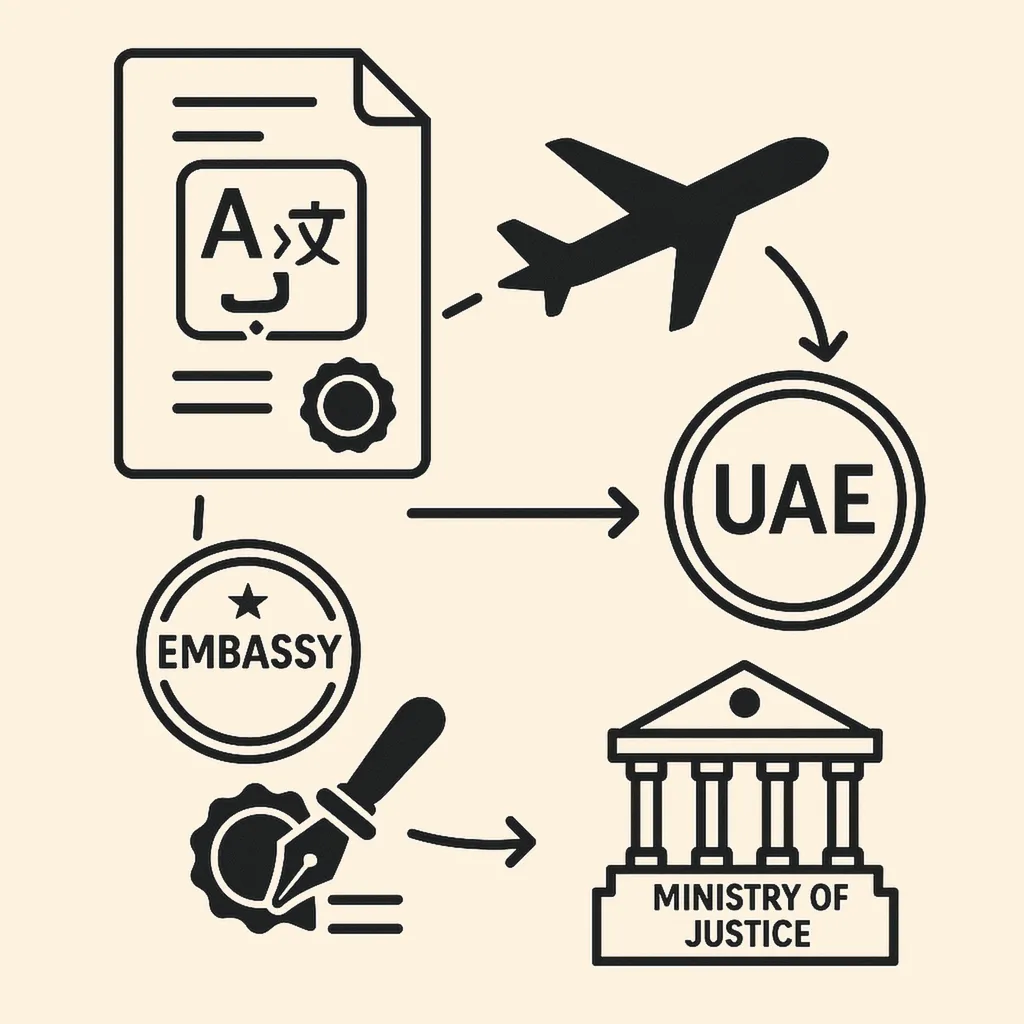
- Notarized or legalized if necessary (e.g., in the foreign country, by the UAE Embassy, and MoFAIC).
- Clear and legible; damage or missing sections can cause rejection.
Tip: Always check whether your document must be attested before translation. Al Rahmaniya Legal Translation can guide you on the sequence: attestation first, then certified translation, then any final stamps required inside the UAE.
2. Use of MOJ Certified Translators in Dubai
For a translation to be recognized as certified or sworn in Dubai, it must be prepared by a translator registered with the MOJ and authorized for the relevant language pair (for example, English to Arabic, French to Arabic, Russian to Arabic).
At Al Rahmaniya Legal Translation, only MOJ-approved professionals handle documents that need sworn translation Dubai. This ensures that:
- Your translations carry the correct seals and declarations.
- They are compatible with the requirements of Dubai Courts, notaries, and ministries.
- The translator’s name and license number can be verified if needed.
3. Formal Layout, Stamps, and Translator Declaration
A valid certified translation typically includes:
- The translated text mirroring the structure of the original document.
- A formal statement (declaration) from the translator confirming that the translation is “true and accurate” to the original.
- The official stamp of the MOJ certified translator Dubai, including name and license number.
- The translator’s signature and date of completion.
Some entities may also require the translator’s stamp or signature on each page. ARLT can adapt formatting based on the target authority (for example, Dubai Courts vs. a foreign embassy).
4. Language Direction and Combinations
Certified translation may be required in different directions:
- From foreign language to Arabic: common for court, immigration, and company processes.
- From Arabic to foreign language: common when submitting UAE documents abroad.
Always confirm which language version is required. For instance, a Dubai court might only need Arabic, while a foreign university needs English translations of your Arabic documents.
Validity Period of Certified Legal Translations in Dubai
One of the most frequent questions clients ask is: “How long is my certified translation valid?” The answer depends on both the type of document and the authority using it.
General Principle: Translation vs. Underlying Document
The translation itself usually does not “expire” as long as:
- The content of the original document remains unchanged.
- The legal status of the underlying document remains valid (for example, a still-active passport or corporate license).
However, many authorities set their own validity rules for the document you are translating. For example:
- Police clearance certificates are often accepted only if issued within the last 3 months.
- Bank statements may need to be less than 30 or 60 days old.
- Medical fitness certificates have limited validity.
In such cases, you may need a new document and a new translation when the validity period lapses.
Typical Validity Scenarios
| Document type | Typical treatment of translation validity* | Practical recommendation |
|---|---|---|
| Birth, marriage, death certificates | No strict time limit on translation if the original remains valid and unaltered. | Can often reuse the same certified translation for future processes, unless the authority requests a recent version. |
| Education diplomas and transcripts | Generally no expiry; translations remain valid unless formatting rules change. | Keep digital and hard copies safely; reuse where accepted. |
| Police clearance, bank statements, medical reports | Linked to underlying document validity (often 1–3 months). | Plan to reissue and re-translate if submission is delayed. |
| Company licenses, MOA, commercial registry docs | Valid as long as company details remain unchanged. | Update translations after major amendments (name, ownership, activities). |
*Always confirm with the specific authority (court, ministry, embassy) because internal policies can change.
When you Should Consider Re-Translating
You may need a fresh certified legal translation Dubai if:
- The original document has been reissued or updated (e.g., new passport, renewed license).
- The authority explicitly demands a translation not older than a certain date.
- Regulations or formatting standards have changed (common with immigration and professional licensing).
- The previous translation was not done by a recognized MOJ-certified provider and was rejected.
Al Rahmaniya Legal Translation can review existing translations and advise if they are still acceptable or require updating.
Step-by-Step: How the Certified Legal Translation Process Works
Working with a reputable provider in Dubai makes the process straightforward. Below is how it typically works with ARLT.
Step 1: Document Assessment and Requirements Check
You share scanned copies or clear photos of your documents via email or secure online upload, or you visit the office in Dubai (Business Bay / Sheikh Zayed Road access). The team will:
- Identify whether certified legal translation in Dubai is required or if a standard translation is enough.
- Confirm the language pair and intended authority (e.g., Dubai Courts, MoFAIC, a particular embassy).
- Check if attestation or legalization steps are needed before or after translation.
Step 2: Official Quotation and Timeline
You receive a quotation based on:
- Number of pages or word count.
- Language combination and complexity (e.g., contracts vs. certificates).
- Urgency (standard vs. express service).
Al Rahmaniya Legal Translation is known for fast turnaround times in Dubai while maintaining legal accuracy.
Step 3: Translation by a MOJ Certified Translator Dubai
An appropriate MOJ-certified translator handles your file, ensuring:
- Terminology matches UAE legal usage.
- Names, numbers, and dates precisely reflect the original.
- Formatting aligns with the expectations of the end authority.
Confidentiality is critical, especially for litigation, financial, and corporate documents. ARLT follows strict data protection and privacy practices.
Step 4: Internal Quality Review and Certification
Before delivery, a second reviewer or senior translator checks:
- Consistency between original and translation.
- Correct application of stamps, declarations, and signatures.
- Any special formatting, such as tables, seals, and handwritten notes.
The translation is then printed on official letterhead (if applicable), stamped, signed, and dated by the sworn translator.
Step 5: Delivery and Further Attestation (if required)
You can receive:
- Hard copies with original stamps for submission to Dubai based authorities.
- Scanned copies for preview or online submissions where accepted.
If the translation needs further attestation (e.g., court stamping, MoFAIC, or embassy legalization), Al Rahmaniya Legal Translation can advise or coordinate the next steps.
How to Choose a Reliable Certified Legal Translation Provider in Dubai
Not all translation services can offer true certified legal translation Dubai. Use the following criteria when selecting a provider.
1. MOJ Approval and Licensing
- Verify that the provider works with MOJ certified translators for the needed language pair.
- Ask to see sample stamps or evidence of previous work accepted by Dubai authorities.
Al Rahmaniya Legal Translation focuses specifically on legal and certified work, including court, corporate, and immigration documentation.
2. Legal Specialization and Local Experience
- Prefer agencies that specialize in legal document translation Dubai rather than general content only.
- Ensure they have experience with your specific use case (e.g., Business Bay company setups, Sheikh Zayed Road notary procedures, family court matters).
3. Turnaround Time and Capacity
Deadlines are often tight in court filings, tenders, and visa applications. Ask:
- How long it will take to translate your documents.
- Whether express or same-day services are available for urgent files.
- How they manage large projects (e.g., multi-contract arbitration bundles).
4. Confidentiality and Data Security
Legal and corporate documents frequently contain sensitive data. Your provider should have:
- Clear confidentiality policies.
- Secure file transfer and storage procedures.
- Non-disclosure agreements (NDAs) available upon request.
5. Transparent Pricing and Support
A trustworthy provider will offer:
- Clear pricing (per page or per word) without hidden fees.
- Guidance on attestation, legalization, and submission requirements.
- Responsive communication via phone, email, or in-person in Dubai.
Frequently Asked Questions About Certified Legal Translation in Dubai
Usually not. For most visa, court, and notary procedures in Dubai, you need certified legal translation by an MOJ approved translator. Standard translations without official stamps are typically rejected by government entities.
For the translation work itself, a clear scan or copy is often sufficient. However, the authority where you submit the documents (courts, immigration, embassies) may require you to show or submit the original or an attested copy. ARLT will advise based on your specific case.
In most cases, no. Dubai authorities typically request translations done by a MOJ certified translator Dubai. Foreign “sworn” or “certified” translations may not be recognized unless they are retranslated or endorsed locally.
Timeframes depend on volume and complexity. Simple certificates can sometimes be completed within the same day, while large contracts or court bundles may take several working days. Al Rahmaniya Legal Translation offers express options for urgent files, subject to availability.
Many Dubai authorities still require original, stamped hard copies. However, some online platforms and foreign institutions may accept scanned copies. ARLT usually provides scanned versions for your records and can supply multiple stamped hard copies upon request.
Conclusion: Secure Your Certified Legal Translation in Dubai with Confidence
Whether you are an individual managing immigration and family matters or a company handling contracts, court cases, or corporate filings, certified legal translation in Dubai is a critical step you cannot afford to overlook. Using MOJ-approved translators ensures your documents are accurate, compliant, and recognized by Dubai Courts, notaries, ministries, and international bodies.
Al Rahmaniya Legal Translation supports clients across Dubai from Business Bay start-ups to established firms on Sheikh Zayed Road with fast, precise, and confidential legal translations and attestation support. If you are unsure whether your documents require certified or sworn translation Dubai, the ARLT team can guide you through the requirements, validity considerations, and best next steps.
To deepen your understanding of how to evaluate and choose the right translation partner, including additional criteria for legal, technical, and official document services, explore the main guide here: Read complete overview: “The Complete Guide to Choosing a Legal Translation Company in Dubai for Document Translation and Attestation Services.”
When your legal rights, immigration status, or business interests depend on a few pages of translated text, make sure they are in the hands of experienced MOJ certified professionals in Dubai.